Codex CLI Integration
Configure Codex CLI with an LLM Gateway provider, connect your API key, and verify file edits and test execution.
Codex CLI can connect to LLM Gateway through a custom provider using the Responses API. This walkthrough was verified with Codex CLI 0.153.4.
Video walkthrough
Install
pnpm add -g @openai/codex
codex --version
Configure LLM Gateway
Create a key in your dashboard and export it in the terminal where you launch Codex:
export LLMGATEWAY_API_KEY="your_api_key"Merge these settings into ~/.codex/config.toml:
model = "deepseek-v4-flash"
model_provider = "llmgateway"
model_reasoning_effort = "low"
web_search = "disabled"

[model_providers.llmgateway]
name = "LLM Gateway"
base_url = "https://api.llmgateway.io/v1"
env_key = "LLMGATEWAY_API_KEY"
wire_api = "responses"
The named provider reads your gateway key from the environment. You can keep your existing ChatGPT login. Current Codex versions use responses; changing an environment variable cannot switch them to Chat Completions.
Web search is disabled for this example because the selected model does not support native web search. Enable it only after selecting a model with that capability in the catalogue.
Start coding
cd your-project
codex
For a scripted task:
codex exec --sandbox workspace-write "Fix the failing test and run it again"Verify the connection
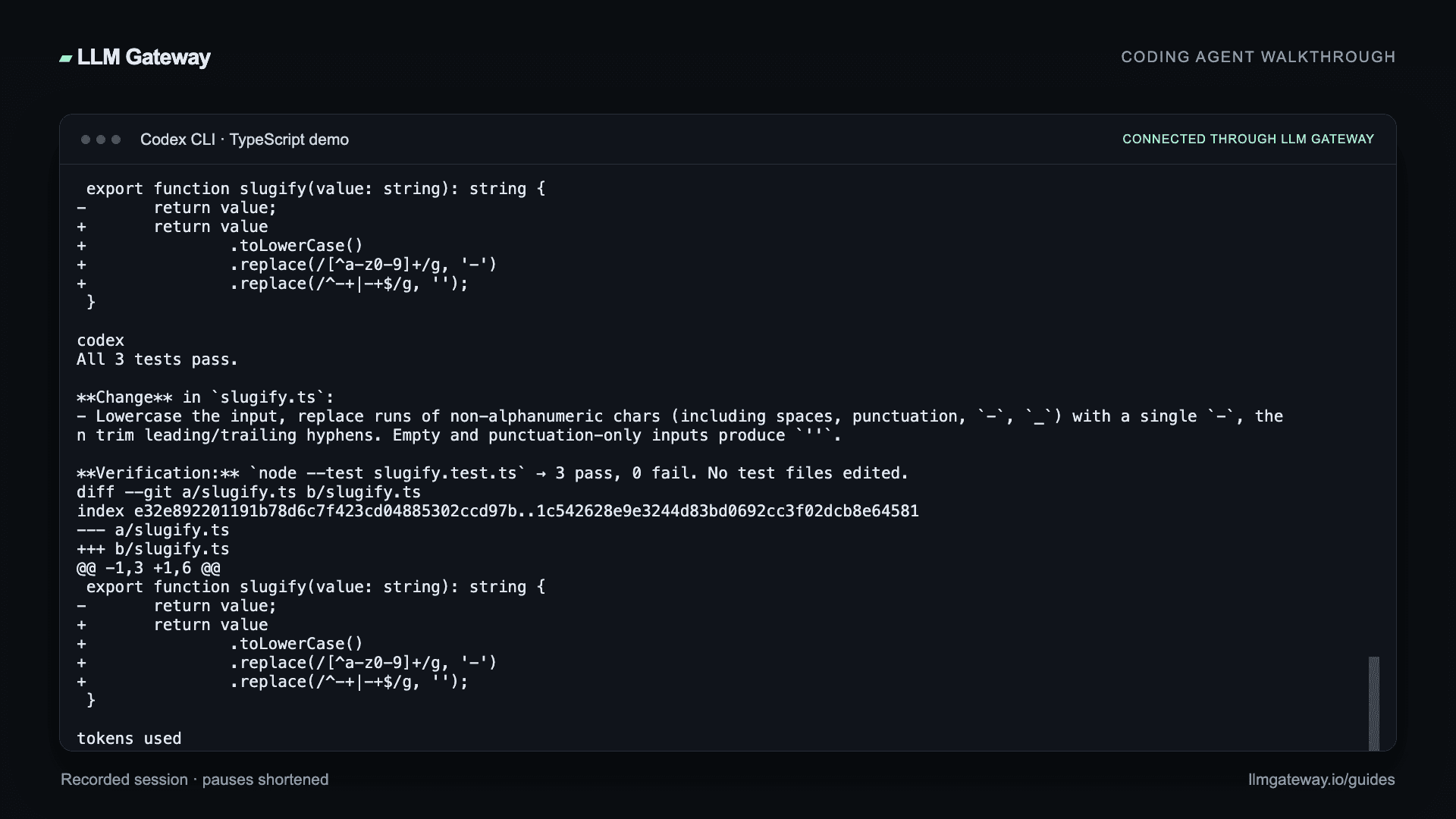
Open a small project and ask the agent to read a file, make a change, and run its tests. Our recorded example fixes a TypeScript slugifier and passes all three tests with deepseek-v4-flash through LLM Gateway.
Hello, LLM Gateway! becomes hello-llm-gateway; repeated separators collapse into one hyphen; empty and punctuation-only inputs stay empty. The demo uses Node.js 24 to run node --test slugify.test.ts directly.
Review the diff and test output, then check the request in your LLM Gateway dashboard. Choose other compatible models from the live catalogue.
Troubleshooting
- Authentication fails: check that
model_providermatches the provider table and thatLLMGATEWAY_API_KEYis exported in the same shell. - Native web search is unsupported: set
web_search = "disabled", then start a new session. - Model metadata or catalogue refresh warning: Codex 0.153.4 can warn about missing metadata or the gateway's model-list response format. Our configured model still completed the task. Use an explicit model ID and verify the actual request result.
- Wrong endpoint: the provider's
base_urlmust end in/v1.
See OpenAI's custom-provider configuration for configuration profiles and other options.
How is this guide?
Last updated on
Cline Integration
Run Cline, the autonomous VS Code coding agent, on Kimi K3 or 200+ models through LLM Gateway. One OpenAI-compatible endpoint, full cost tracking.
Continue CLI Integration
Point Continue CLI at Kimi K3, GPT-5, Claude, or 200+ models through LLM Gateway. One config file, unified billing, full cost tracking.